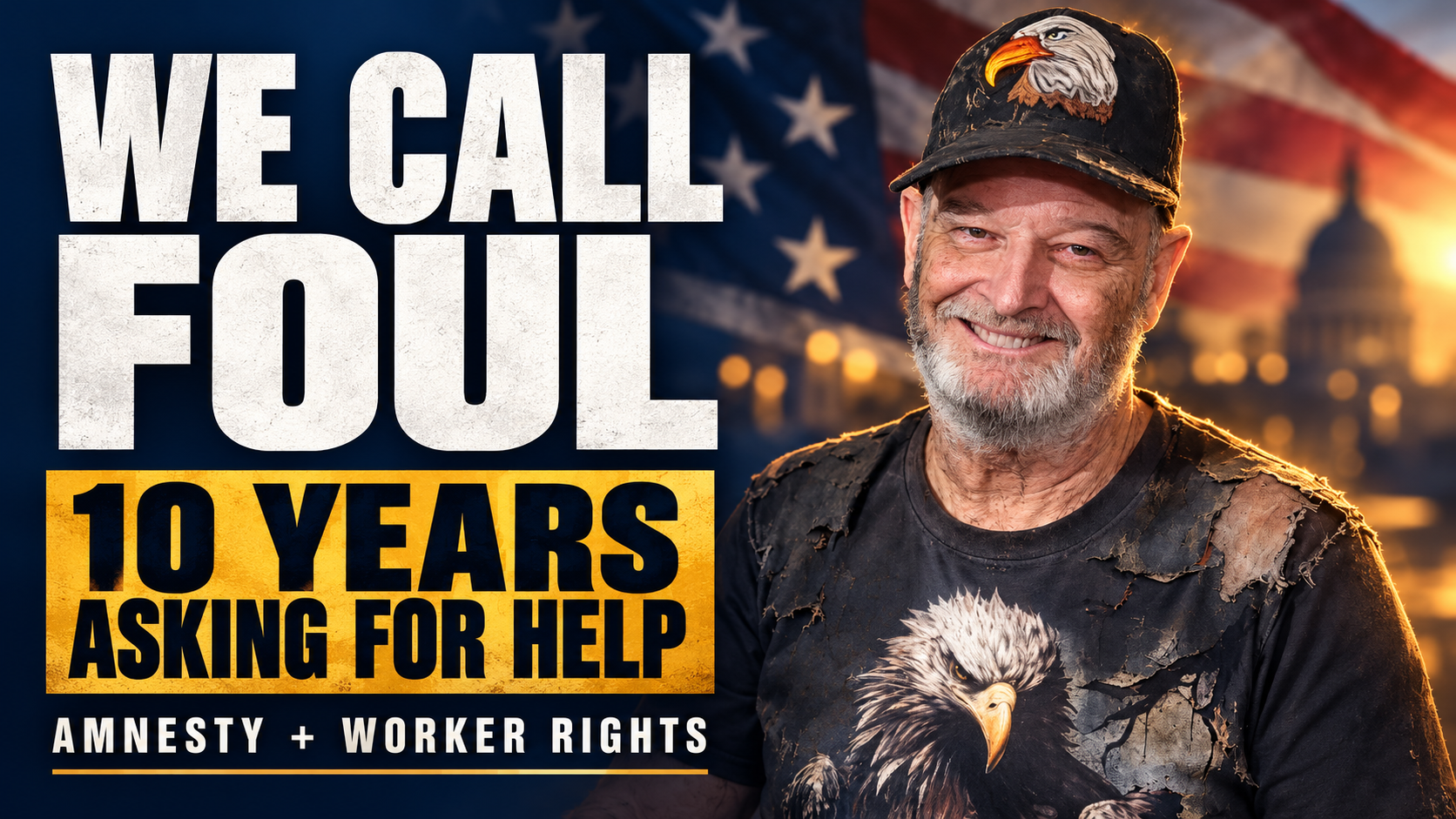
Amnesty. Family unity. Federal protections for injured workers. Put those commitments on the table, name the people responsible, and tell us what happens next.
For ten years I have asked my own political side to make room for those demands. I support universal health care. I also want a worker who gets hurt to have enforceable protections for lost income, disability, rehabilitation, and a fair process. I want mixed-status families to have a permanent future together. These belong in the same conversation.
My new film, WE CALL FOUL — Newsroom Edition, brings together my appeals, original calls, public speeches, correspondence, and the questions I still want answered. It opens with part of my song, My Father’s Voice, and closes with the complete song. Between them is the record I have been trying to get people to hear.
“Low priority” is an answer we need to examine
On September 30, 2026, Christoph Mair, a legislative assistant for Representative Liz Berry, wrote that “emails sent to the entirety of the Legislature are often low priority.” His explanation also cited the volume of mail offices receive and directed me to Representatives Mary Fosse and Julio Cortes and Senator June Robinson, who represent Everett. He noted Fosse’s place on the House Labor and Workplace Standards Committee.
That context matters. So does the question I am asking.
I understand why an office sends constituents to their district representatives. But a demand for national worker protections and family unity reaches beyond one district. If every office sends the question somewhere else, who takes responsibility for coordinating an answer?
I will keep contacting my own representatives. I will also keep asking the wider Legislature and Congress to respond to the policy demands. Give us a responsible office, a hearing, a proposal, and a date. A family living with the consequences needs more than another referral.
The history is in the recordings
The film preserves a Sent-mail header dated September 21, 2016. Its subject asks why minimum federal wage protections are acceptable while minimum federal workers’ compensation standards are treated differently. The outgoing recipients include addresses associated with Marko Liias, Lillian Ortiz-Self, Patty Murray’s office, Kshama Sawant’s office, and Pramila Jayapal’s campaign. That header documents an outgoing appeal. It does not prove each person personally read it.
A recorded appeal preserved from 2018 makes the national-standards question audible in my own voice. The film also includes my exchanges with Thom Hartmann and labor radio, Kay Tillow’s argument about national versus state health-care strategy, and conversations involving Tyler Vega.
Those conversations contain disagreements, referrals, and offers of help. They belong in the record too. An offer is a starting point. My question is what action followed, and what enforceable protection a worker or family gained.
In the Marko Liias presentation I supplied, competitive rates and business rankings help make the case for Washington’s workers’ compensation system. I want the worker’s scorecard beside that business scorecard: timely benefits, adequate income, meaningful rehabilitation, independent medical accountability, and a fair hearing.
Rick Larsen’s campaign discussion of costs and health care raises another question for me: where do lost wages after an injury and permanent family security enter the affordability agenda? A short speech cannot summarize a lawmaker’s whole career. It can open a specific public question about what that lawmaker will advance now.
Credit the record. Demand the next step.
There is a public record of people raising workers’ compensation concerns. In 2015, Murray, Bernie Sanders, and Bobby Scott urged stronger federal oversight of state programs. The Labor Department’s 2016 report examined deteriorating protections and the resulting costs to workers, families, and public programs. Robert Reich discussed workers’ compensation and the shifting of risks onto workers in his 2021 Senate testimony.
Those records matter. I am asking what has been done with those warnings and what comes next. A warning on paper and an enforceable guarantee in a worker’s life are different things.
My challenge to Reich, Sanders, Murray, Sawant, Jayapal, Liias, Ortiz-Self, Cortes, Fosse, and Larsen is direct: answer the demands presented here. Name the action you support, the action you oppose, and your reasons. If you have contrary records or corrections, bring them forward.
Jon Stewart’s advocacy for 9/11 responders shows the importance of sustained public attention. I want that attention extended to injured workers whose losses never become a national television story. I want Hartmann and other broadcasters to follow the worker’s question through to the officials’ answer.
Make room at our own table
Whole Washington’s own website supports both statewide and national universal-health-care efforts. I support making care available to everyone. My demand is that the movement also confront income loss, disability, employer responsibility, and due process after a workplace injury.
Health coverage does not, by itself, answer every one of those questions. Show workers the safeguards and the gaps. Bring injured workers into the room when the agenda is written.
The same request goes to unions, Reverend William Barber and the broader anti-poverty movement, disability organizations, and LGBTQ advocacy groups. Equality should expand the table. I want these movements to put injured workers and mixed-status families into their public commitments and decision-making.
I have felt dismissed and pushed aside, including in disputes with people I once expected to help. The film describes my account of those encounters. My criticism deserves examination alongside complete records and responses. There is also current agency correspondence and review; those replies should remain visible as we press for accountability.
Put the commitments in writing
Here is what I am asking elected officials and movement leaders to do:
- Advance enforceable federal minimum workers’ compensation standards. Address benefits, lost income, rehabilitation, disability, and fair process.
- Support a national workers’ compensation commission with injured workers at the table. Give workers a continuing role in evaluating the system.
- Demand independent medical-examination accountability and accessible review. Explain how workers can challenge errors and obtain a fair hearing.
- Put broad legalization, amnesty, and family unity on the agenda. Defend families’ permanent security alongside health care and worker protections.
- Provide a coordinated written response. Name a responsible office, a sponsor or proposal, a hearing or meeting, and the next date for action. State officials can hold oversight hearings and press Congress; federal officials must answer the national demands.
I am asking for peaceful public advocacy, documented answers, and a place in the decisions that shape our lives.
My father’s voice still rings in my head. So do the fights our fathers carried before us. I turned that anger and inheritance into a song because I want people to hear the human being behind the repeated emails.
We call foul when promises keep replacing commitments. We keep asking because our families and injured workers deserve to be heard—and because we still expect our own side to answer.
About the film: Independent advocacy by Darren Fonzseau. Its male and female news presenters are fictional AI hosts. Original recordings are identified; illustrative and symbolic visuals are not historical evidence. The film and this op-ed present personal accounts and policy demands, not findings of coordinated misconduct. Complete records, specific corrections, and responses are welcome.
Records and further reading: The September 30 email is Darren’s supplied correspondence. Dated archive material and editorial limits are listed in the accompanying source ledger. Public primary sources include: